


The favorable January 17th court ruling for Masimo Corporation in its blood oxygen sensor IP battle with Apple has caused problems for the world’s largest consumer electronics company. The ruling effectively forced Apple to stop selling watches with oxygen measurement features in the U.S. until the appeal process for the ban was finally decided.
The bulk of Masimo's patent claims are on a system level. The foundational IP of how the system physiologically functions is on the light detector level. Notably, the two Masimo patents (patents '502 and 648) that the US International Trade Commission (ITC) recognized in its October 2023 decision mainly validated its light photodiode claims. Specifically, the ITC found Apple in violation of section 337 only to claims 22 and 28 of the '502 patent and claims 12, 24, and 30 of the '648 patent. The ITC then issued an order prohibiting the importation of ‘certain light[1]based physiological measurement devices and components thereof’ that infringe upon claims 22 -and 28 of the '502 patent and claims 12, 24, and 30 of the '648 patent.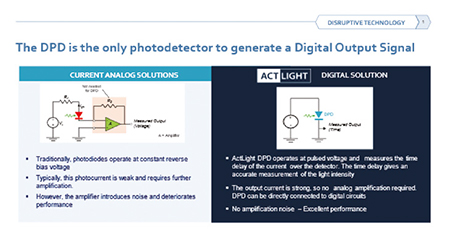
Claims 22 and 28 of the '502 Masimo patent and claims 12, 24, and 30 of the '648 Masimo pate-nt describe a user-worn device having light-emitting devices and photodiodes. But what if Apple discovered a light-emitting device that does not use photodiodes as constructed today? Apple could then bypass Masimo's IP roadblock and operate in the free and clear.
The answer to Apple's quandary may be Lausanne-based ActLight. This company has developed a unique dynamic photodetector (DPD) light sensing technology that generates an accurate digital output signal without amplification with very low operating voltage. This fundamentally differs from today's less accurate, bulky, power-hungry, constant-voltage photodiodes used by Masimo and others in the industry.
ActLight has over 30 granted patents and a large number of filed patents covering DPD technology and different applications. ActLight's founder is the inventor of DPD technology, and ActLight has recently become the sole owner of all granted and filed DPD patents worldwide.
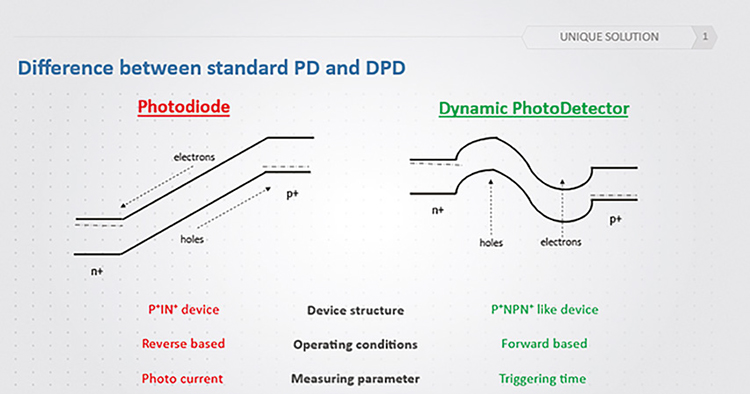
Specific to Masimo's patent, ActLight's DPD is not a photodiode. It differs from a photodiode by construction, operating conditions, and the measured parameters. ActLight's unique DPD has a P+NPN+ device structure (not a P+IN+ device structure), has forward-based operating conditions (not reversed-based), and is a time-triggered measuring system (not photocurrent-based).
Page 89, 2nd paragraph of Masimo patent US010945648 B2 (i.e., '648) states: ‘In an embodiment, the front-end may comprise switched capacitor circuits that are configured to convert the output of sensor's detectors into a digital signal.’
As the fund manager of the Quan Technology Fund, which is an investor in ActLight, I questioned ActLight's CEO on how its DPD technology gets around this broad 'detector' claim. The ActLight CEO responded, "DPD technology does not require any capacitor, and the output signal is already digital", removing the last doubt from my mind.
"Apple can easily incorporate ActLight's DPD into its future smartwatch designs, and not only avoid Masimo's patent claims but come out with a superior device that could take market share away from Masimo"
Based on the facts above, I believe that a device such as the Apple Watch that uses DPDs instead of photodiodes could likely avoid an infringement with Masimo patents. Moreover, the high performance (high signal-to-noise ratio), minimal voltage, low cost, small size, tuneability, and direct digital output creates enormous advantages to the state-of-the-art photodiodes being used by Apple, Masimo and the industry today.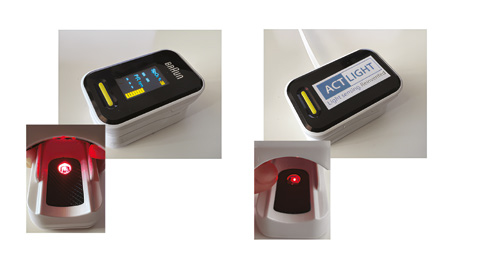
The icing on the cake is that ActLight's DPD technology is licensed to a major Apple semiconductor supplier for heart rate monitoring, which has been thoroughly tested and is ready for volume production in April. Furthermore, a similarly designed peripheral oxygen saturation (SpO2) prototype was successfully tested at 110 dB. I witnessed the demo firsthand against the market leader's state-of-the-art blood oxygen sensor; ActLight's sensor was exponentially smaller, drew much less power, and reacted quicker to changes if needed (see side-by-side photos below).
Thus, Apple can easily incorporate ActLight's DPD into its future smartwatch designs and not only avoid Masimo's patent claims but also come out with a superior device that could take market share away from Masimo.
